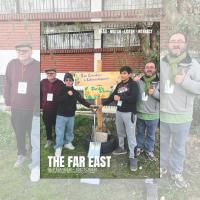
Young people gather for a special Stations of the Cross, praying for those who carry the many crosses of life in Myanmar. Photo: Kurt Zion Pala
Soon after the pandemic, the military declared a coup on the alleged basis that there had been massive cheating after the last elections in 2021. But the people had already gained access to greater education and freedom through the internet. They were able to encounter the world outside of Myanmar. Now, years after the coup, many areas of Myanmar are under the control of different ethnic-armed organisations. Myitkyina in the northernmost part of the country remains in a fragile situation. The Kachin Independent Army, assisted by the many young people who have joined the People’s Defence Force (PDF), continues to fight. There have been weeks of shelling in areas around the city. In many townships, the fighting has led to a large number of casualties even among civilians.
On the Exaltation of the Holy Cross, every September 14, a huge crowd used to gather at the foot of Holy Cross Mountain and climb it as a pilgrimage. Last year, with the roads to the mountains now controlled by the Burmese army, the Myitkyina Diocese decided to keep the celebrations simple in every parish. Many fear being checked and arrested.
When I recently travelled to Yangon to take a few days off and get some resources for the student centre in Myitkyina, I met many alumni of the Catholic Student Action Myitkyina. It was great to see them again after such a long time. This group of students was among the first that joined the movement. I asked one of them, “When are you returning to Myitkyina?” He replied, “Never.” That would be the common answer for many young people who are now displaced by the ongoing war and conflict in every part of Myanmar.
These young people have only one dream: to leave the country. As a result, we are losing badly needed human resources such as teachers and mentors. Even in church, I overheard one catechist ask an elderly person to learn to play the keyboard because, he explained, whenever he trained a young person to play or when a young person could already play, they always left after a few months to go abroad for work.
On the Feast of the Holy Cross, we decided to celebrate with a special Stations of the Cross for the youth. About forty young people joined the activity. In place of the 14 stations, we highlighted different struggles and challenges young people in Myanmar continue to face today, representing the 14 crosses they face:
- War and conflict in Kachin land
- Violence against women and children
- Young persons in prison
- Child labour
- Climate change and pollution
- Internal displacement
- Poverty
- Mental illness
- Human trafficking
- Inadequate access to education
- Unemployment
- Broken families
- Drug addiction and HIV/AIDS
- Teenage pregnancy and abortion
At every station, we read a reflection and paused for a few minutes to pray for young people struggling with that particular cross. We then prayed together for the intentions of these young people.
At the last station, a huge cross was placed in front of the grotto to remind the young people that they were not alone. The cross reminded them that there is hope in their suffering and struggles.
Life in Myitkyina is not getting easier. Prices of basic commodities have increased. Phone connection is poor, and internet access has been restricted. Now you need to go to “internet shops” to access the internet.
Returning from Yangon to Myitkyina, I was stopped by the immigration at the airport when they saw the small amount of cash I was carrying. For a few seconds I panicked before getting hold of myself. It was a good thing I still remembered my Burmese as in Myitkyina I mostly speak Jingpo - the Kachin local language.
I spoke to them to explain what I was doing in Myitkyina: “Krian Ponjee, I am a Christian monk. I work for the Church. I teach English to young people.” That is mostly how I explain myself to people here. I have to be careful with the words I use to avoid suspicion. The female officer smiled after hearing me speak in Burmese. I was relieved after she told me to go.
Living in Myanmar for the last six years has taught me to live one day at a time. It is very difficult to make plans, as situations can change in an instant. But it has also taught me to be grateful even more for the little things. It has taught me to be more compassionate and generous. It has taught me, above all, to be hopeful.
I kindly seek the help of our readers to bring some relief and hope to many distressed young people through your support for our Student Learning Resources Centre (SLRC) and the Catholic Student Action Myitkyina (CSAM) movement. We provide leadership, livelihood, and employability-skills training to build the resilience and confidence of young people to face these daily struggles.
Over the last two years, we have formed and prepared 54 students through our Positive Youth Development Certificate Program. Currently, 24 new students are participating in Batch 4. They will undergo nine months of training in English, Computing, Accounting, Life-Work Skills, Personal Development, and Entrepreneurship. We also provide additional training in English, Computer Science, Teaching Skills, Leadership Skills, and Mental Health Awareness and Interventions to hundreds more.
Thank you for your support and prayers.
Columban Fr Kurt Zion Pala lives and works in Myanmar.
Listen to "The crosses we carry"
Related links
- Read more from The Far East - September/October 2026