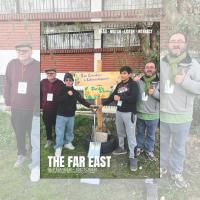
Columban student Jinwook Kim visits an isolated village in the interior of Sindh, where Hindus and Christians live side by side in harmony with fellow Columbans, Frs Iowane Naio (seated on the left), Jerry Lohera (standing on the left side) and Columban student Zau Mai Peter (standing on the right). Photo: Jinwook Kim
My pastoral experience in Badin, together with the gradual acceptance of my own limitations, has deepened my understanding of what it truly means to be present with others.
When I arrived in Badin on 24 September 2025, I began visiting parishioners who live far from the parish house where I stay with Columban Frs Pat Visanti and Elbert Balbastro. Two insights emerged during these encounters. The first was an unexpected sense of solidarity between me, as a foreigner, a stranger and at times a vulnerable person in this country, and Pakistani Christians. This sense of connection became especially clear through the stories of ordinary people living at the margins.
One moment that left a deep impression on me was my meeting with a farmer in Jati village, nearly three hours from Badin. He told me how he had lost his farmland after local Muslims illegally claimed ownership. Although the land was rightfully his, he was powerless to resist. His anger, frustration and sense of abandonment were unmistakable. Listening to him, I realised that while I could never fully grasp the pain of such an experience, I could recognise the helplessness and vulnerability that come with being unprotected in society.
His story reminded me of a difficult chapter in modern Korean history. In the 1970s and 80s, before the Seoul Olympic Games, the government forcibly removed poor families from their homes to clear slum areas and present an image of national progress. Similar injustices occur across the world, yet this memory came to me vividly, allowing me to connect more personally with the struggles faced by the people I met in Badin.
The second insight came from a more personal place: my year-long experience of illness in Pakistan. I found myself exposed to extreme climates, contaminated water, heavily fertilised vegetables and oily food, resulting in fever, chills, allergic reactions, gout and even dental problems. Each period of illness brought frustration, sadness and a sense of powerlessness, especially when I could not carry out my pastoral duties.
Added to this were the occasional feelings of being unsafe or unwelcome due to my East Asian appearance, a consequence of current political tensions in the region.
In reflecting on these experiences, a particular Gospel passage came to mind: “Jesus himself came near and went with them, but they were kept from recognizing him.” (Luke 24:15-16). Like the disciples on the road to Emmaus who did not recognise Christ at first, I, too, realised that God often draws close to us quietly - in our exhaustion, in our uncertainty and in the fragile places where we feel least in control. This verse helped me understand that companionship in faith is not always dramatic; it often unfolds in silence, in vulnerability and in the simple act of walking alongside others.
In this context, I had no choice but to accept the limits of my body and the reality of circumstances beyond my control. Gradually, I recognised that I shared something profound with Pakistani Christians - the experience of fragility, uncertainty and endurance.
This realisation allowed me to encounter others more deeply. After recovering from illness, I returned to parish life with renewed sensitivity. Attending Mass with parishioners and children once again filled me with joy and hope. Their sincere presence, their simple faith and their quiet resilience taught me that evangelisation is not only about what I do, but also about who I am for others. Their presence evangelised me.
Reflecting on the heart of Jesus - his deep compassion for all people, even for his enemies - I was reminded of his tenderness towards the poor, the marginalised and the sick, shown even when he himself was weary. His ministry was, above all, a ministry of presence. My time in Badin during my two-year First Missionary Assignment in Pakistan has helped me understand this truth more deeply. To be present with others is not merely a pastoral duty - it is an act of love, solidarity and faith.
Columban student Jinwook Kim is on his two-year First Missionary Assignment in Pakistan.
Listen to "Faithful companionship"
Related links
- Read more from The Far East - September/October 2026