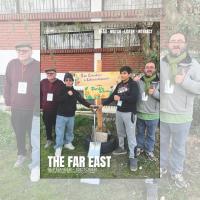
Eric Siraj, administrator (second from the left), Columban Fr Robert McCulloch (centre) amongst the staff at St Elizabeth's Hospital in Pakistan. - Photo: Fr Robert McCulloch
Annual medical statistics are useless for a person who is illiterate and sick and wants pain relief. It’s a fact that last year, Pakistan spent only 1% of its GDP on health, but what’s the point in telling that to a grindingly poor mother whose husband is an illiterate agricultural labourer and whose child is desperately ill?
Sitting over a minimal meal with him and the other children, she says: “Oh, I walked to the local clinic. But they told me that all the doctors are in the big cities so there is no healthcare for us. Our child is going to die.”
Australia has a well-publicised crisis in public and private healthcare, which affects delivering realistic and affordable health care. Is this due to prioritising the costly advice of consultants, “over the top” building plans and equipment purchase agendas, lack of qualified staff, or government over-regulation?
For different reasons, Pakistan also has a serious healthcare crisis. Government expenditure on healthcare is low, and most of that goes to the cities, where the big voter bases are, with little remaining for the rural areas. There was an increase in doctors, but many of these new doctors were women who were seen as “good catches” in the arranged marriage system and ceased to be healthcare professionals.
The number of midwives decreased. But the statistics don’t connect poverty and illiteracy with the healthcare that should be available to all but isn’t.
St Elizabeth’s Mobile Medical Outreach makes a huge difference by giving free primary healthcare with free medicines to more than 50,000 people in rural areas of Sindh province every year. In 2024, 52,921 were cared for, of whom 23,814 were female, 15,876 were male, and 13,230 were children under five. Most are illiterate, and all are poor agricultural labourers and their families. They are Muslim, Christian and Hindu.
In 2009, I proposed and urged as chairman of St Elizabeth Hospital that we should do something to give healthcare to these totally poor and isolated people even though St Elizabeth was then in a crushing financial crisis and had little income. We had no money, but we had a conscience.
I was motivated by two things. I had worked amongst marginalised Hindu tribal people in the Thar Desert at Badin, 100 kilometres from Hyderabad. I saw that they had no medical care. In 1985, with the help of Irish and Australian St John of God Sisters in Punjab, I began a vaccination programme for tribal infants and children who were neglected by government health officials due to religious discrimination. Immediately, the serious diseases of measles and whooping cough were conquered. Fr David Kenneally, an Irish Columban priest in the next mission station 50 kilometres from Badin, extended the successful TB mobile control from there, and our vaccination programme spread to that area. It was the beginning of preventative healthcare. But we both knew that it didn’t cover enough. That led to my determination to make better healthcare available to the poorest who had nothing and were on the fringes.
St Mary MacKillop, the founder of the heroic congregation of the Sisters of St Joseph and the first Australian saint, was my other inspiration. She said to never see a need without doing something about it.
And so we began: no money, a broken-down vehicle, committed Muslim doctors, and enthusiastic Christian male and female nurses.
“Father, it’s never been done before.”
“Yes”, I replied, “and we have no money, so start praying!”
The Columban benefactors came to our aid. Very slowly, they came, but we knew we were doing the right thing at the right time. One donor funded the purchase of a new vehicle in 2016.
We know we make a difference. During the recurring monsoon floods near Hyderabad in south Pakistan in 2023, one of our 24-hour Mobile Clinics met a Pakistan military truck loaded with food supplies. The soldiers said: “We don’t have the planning for medical care. You keep doing the medicals. We will look after the food supplies.” It was a great collaboration. It shows how much the Mobile Medical Outreach at St Elizabeth Hospital integrates the Catholic Church and Catholic values of care into the wider aspects of Pakistan.
 Columban Fr Robert McCulloch with Fariyad Inayat, a Catholic nurse who is coordinator of the Mobile Medical Outreach. - Photo: Fr Robert McCulloch
There is a positive and harmonious interfaith context to the work of the Mobile Medical Outreach (MMOP). The patients are Muslim, Hindu and Christian, and the MMOP health team are Muslim and Christian. Nirmala Shivjaj is a qualified midwife and belongs to one of the tribal communities in Sindh for whom MMOP has a special focus on giving healthcare. She is pleased that through St Elizabeth she can help her own people while speaking to them in their tribal languages. She focuses on maternal care during the MMOP visits.
Fariyad Inayat, the MMOP team leader, says, “The people we go to are happy that we have come. We are welcomed, and they say: ‘You are the only ones that care about our needs’. I’m happy to be a Christian caring for Muslims, Hindus and Christians.” Dr Syed Sajid Hussain Naqvi says that he has an inner satisfaction and feels blessed by God that through MMOP he can treat patients in such need. They both speak of their anger that ordinary Pakistani people do not get any healthcare from the government, so they are pleased to be part of this caring medical team from St Elizabeth Hospital.
Columban Fr Robert McCulloch worked in Pakistan for 34 years, and currently lives in Rome.
Related links
- Read more from The Far East - May 2025