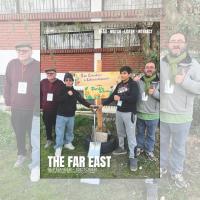
Adam at the ruins of Basingwerk Abbey, Holywell, a 12th Century Cistercian foundation abandoned during the Reformation. Photos: Fr John Boles SSC
Croeso y Cymru (“Welcome to Wales”) announced the sign as we crossed the River Severn, reminding us that the Principality of Wales has a language, history and faith tradition quite distinct from those of neighbouring England.
Ostensibly, we were on a routine Columban ministry, undertaking a weekend mission-awareness visit to a local parish - my colleague, Mr Adam Williams, as our Mission Appeals Coordinator for Britain, and me in my capacity as a Columban priest. However, we had an ulterior motive. Our destination was the North Welsh town of Holywell, the former home of Adam’s ancestors. While there, we were hoping to discover something of his family roots.
Little did we suspect that a series of adventures awaited us.
As we turned inland from the coast road, we were stopped in our tracks by the great, brooding presence of Flint Castle, which guards the approach to Holywell. Dating from 1277, Flint was the first of many fortresses Edward I erected during his brutal conquest of Wales.
Further up the valley, we came across another, but rather more comforting, mediaeval relic - that of Basingwerk Abbey. Built by the Cistercians in 1132, it stood as a testimony to the deep-seated faith of the Welsh people, who’d clung to their Christian beliefs since Roman times. Unfortunately, like all such foundations, Basingwerk eventually fell foul of Henry VIII’s policy of monastic dissolution and was left in ruins. On a happier note, we then spied an ecclesiastical jewel that had miraculously escaped the ravages of the sixteenth-century Reformation - the Chapel Shrine of St Winefride’s “holy well” (giving its name to the surrounding town of Holywell).
Winefride is one of those notable Celtic holy figures of the so-called Dark Ages. She was active in the
seventh century (and, therefore, a near contemporary of St Columban). According to a colourful legend, Winefride fled to the church of her uncle, St Bueno (pron. “Bayno”) to defend her virtue against a violent suitor. She wasn’t quick enough, and her pursuer proceeded to cut off her head, but as the severed head struck the ground, a spring of water gushed forth. Fortunately for Winefride, Uncle Bueno then dashed out and miraculously restored her to life by placing the dismembered head back on her torso. She then enjoyed many years as a holy and much-revered nun.
Whatever the truth of this tale, Holywell became a great place of pilgrimage, first for the Welsh, then for the conquering English. The present structure is an unusual two-storey affair, a magnificent example of late-mediaeval Perpendicular-style architecture. An upper chapel protects a well crypt below, where gorgeous fan vaulting covers the famous spring and pilgrims’ bathing pool. The fact that the shrine was able to “re-brand” itself as a parish church saved it from the attention of the Reformers.
The Bridgettine Sisters at the Pilgrims’ Hostel royally entertained Adam and me before we celebrated the weekend Masses and set off to seek evidence of Adam’s family roots. The Sisters directed us to Holywell Cemetery, perched on a hillside overlooking an impressive stretch of the North Welsh Coast. This graveyard is as beautiful as it is peaceful. There, we traced the resting places of many members of the Williams family and got to kneel and pray awhile by the graves of Noel and Edith, Adam’s great-grandparents. However, our search was not over. In fact, the best was yet to come.
Adam was anxious to locate the last family home the Williamses had lived in before emigrating to England. Tantalisingly, the kind Sisters at the hostel recognised Adam’s description of the place as the one currently serving as a modern-day hermitage, occupied by a Poor Clare Sister duly registered as a hermit by the Bishop of Wrexham.
Knowing roughly where the house lay, we proceeded to knock on doors in and around the vicinity, eliciting some rather bemused reactions from the neighbours as we asked in turn, “Excuse me - but, by any chance, does a hermit live here?” Fortunately, the lady in question was fairly well known, and we soon found ourselves being greeted by an overwhelmingly active and cheerful 80-year-old nun who - by an incredible coincidence - had chosen the former residence of the Williams family as her hermitage some forty years ago.
Delighted to see us, Sr Seraphim recounted her remarkable life history. As a child, she’d been given to an orphanage and raised by nuns. Sensing she had a religious vocation herself, she later asked to join them but was turned down because of doubts regarding her academic ability. Determined to prove them wrong, she left the convent, got a job, arranged further education for herself, and reapplied to the Poor Clares, now armed with outstanding academic qualifications. After serving her Order in a “conventional” manner, she then felt God was calling her to serve Him in a less orthodox fashion as a hermit. She now joyfully lives out her calling through prayer and as a renowned scholar of ancient Hebrew literature and the Jewish Scriptures.
It is true that God has a plan for all of us down the generations. Sometimes, those plans reveal themselves to be fascinating, varied and faith-filled, like that of Columban Co-Worker Adam Williams.
Columban Fr John Boles is the Director of the Region of Britain.
Listen to "The Columban, the Saint and the Hermit"
Related links
- Read more from The Far East - January/February 2025