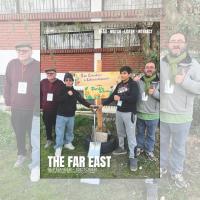
International Women's Day arts and crafts. Photo: Catharina Son Seon Young
"We want to hang our washing out in front."
In March, there was a two-day event in Myitkyina for International Women's Day (IWD) 2024. The theme was “Invest in Women - Accelerate Progress”. Although I was interested, I was a little nervous about attending the event because of my language difficulties. Nonetheless, I decided to go because I thought it would be a great opportunity to hear the voices of women in Kachin State and that this would help me understand their lives better.
The organiser kindly asked a participant, an NGO worker with fluent English, to sit next to me and translate for me. She was very friendly, but unfortunately, she had to leave for another meeting before lunch. Then, a 22-year-old Buddhist girl, Mumu, approached me and tried to help me by speaking Korean, which she had learnt from watching Korean dramas. Although her Korean was limited, we were able to communicate, and Mumu became a good friend and translator for me over those two days.
There were about fifteen young women from Myitkyina, mostly Kachin, but also some from other tribes, and Buddhists, Muslims, and Christians. Because of this variety, the workshop was conducted in Burmese, the official language of Myanmar. We talked about the history of IWD and community activities and made our own art - paintings, bouquets, hair pins and bracelets, and hand-sewn sanitary napkin pouches. The women were all very talented and participated in all the programs.
In small groups, we talked about gender - the differences between women and men, what women and men usually do, etc. It was a great opportunity to hear what they thought about their culture and the status of women in society. A common response from each group was that men play games, go out, and socialise with friends, while women stay home to clean the house and take care of their family members.
The facilitator asked if I could talk about women and men in Korea. There was a time when the roles and responsibilities of the sexes in Korea were very different. For example, women were expected to be housewives and do housework regardless of their profession, and girls were expected to take care of their younger siblings instead of continuing their studies. Men were expected to be the head of the family and thought that housework was not their job. But now, the status of women in Korean society has changed greatly.
The concept of “male supremacy” has disappeared, and women's voices have become stronger. It is socially recognised that women have the same rights and abilities as men. I stressed that we need to encourage and support each other and continue to work towards women's empowerment in this world.
We then shared what changes we would like to see in society. One of the participants said that she would like to see a change where women's clothes were “put out in the front like men's clothes”. This was puzzling to me, but I assumed it referred to the current position of women in Myanmar society. There is a traditional superstition that touching or walking under female garments brings bad luck and reduces male strength. I recalled watching the news when the military coup started in Myanmar and seeing women protesting by hanging their traditional skirts in the streets to stop the military from passing by.
As a foreigner, I think it is important to understand the culture the people grew up in to understand them and learn how to work with them. This is not to judge the culture. Rather, I believe that understanding the cultural background always helps me to find ways to live with and accompany people.
After arriving in Myitkyina last year, I was waiting to return to Banmaw, where we Columban lay missionaries used to work. However, with the civil war showing no signs of ending and the situation in Banmaw becoming more serious, we Columbans in Myanmar decided that the Columban lay missionaries would remain in Myitkyina and work together with the Columban priests. Over recent months, we lay missionaries have been preparing for new ministries in Myitkyina.
I have recently started the Visio Divina (sacred seeing – an ancient form of Christian prayer in which we allow our hearts and imaginations to enter a sacred image) with young women and often meet girls like Mu-mu, who have a lot of dreams. Mu-mu hopes to have more opportunities to learn and forge a career.
Meeting young people like Mu-mu, who have a passion for learning and personal growth, always makes me think about how I can encourage them and help them dream of a bright future and continue to strive for it despite the grim reality of Myanmar right now. I hope the day will come when women can hang out their laundry as naturally as men do - that it will be a reality and not just a dream.
Columban lay missionary Catharina Son Seon Young lives and works in Myanmar
Listen to "A little wish"
Related links
- Read more from The Far East - January/February 2025