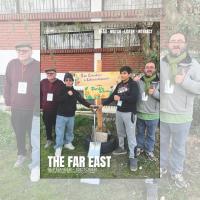
Thomas So Toi Naw (centre) with his wife and a daughter standing outside their restaurant looking down over the rivers - Photo: Fr Frank Hoare
CATHOLICS LIVING IN THE MYANMAR JUNGLE
In Yangon, Myanmar, Sr Rufina (the leader of the Sisters of St Paul) spoke to me of her visit to her family, who had to flee from the military last year to the jungle near Loikaw, in the east of the country. They asked her to bring a statue. Her relatives then mounted it on a plinth they had made to memorialise her silver jubilee of religious profession. She had a dream that night of revisiting her house but was unable in the dream to go into a room upstairs out of fear. She woke up to find that all her relatives were awake and alert at 2 am because an army plane had just flown low overhead, though Sr Rufina hadn’t heard it.
The people told her that when they lived in their village, there were rich and poor. Some of the rich were greedy, and some of the poor were envious and hated the rich. But in the jungle, they discovered that they were all equal and whatever food they found they shared with each other.
The children told her how God had protected them when a bomb fell just behind them but didn’t explode. Sr Rufina contrasted their deep faith and gratitude to God to the complaints of the city people about why God allowed the turmoil in Myanmar to happen.
WHERE THE IRRAWADDY RIVER BEGINS
While staying in Myitkyina, the capital of Kachin State in Myanmar, Fr Leo Gopal, a graduate of our Columban course for formators, took me to the confluence of two rivers, the Maihka (from China) and the Malihka (from India). Here begins the great Irrawaddy River. Chinese business people mine for gold nearby using machines. The local people search for gold along the banks of the river. Some seminarians spend the two months of their summer holiday this way, earning about $8.00 a day. They pay their tuition and boarding fees for a year in the seminary with their earnings.
Thomas So Toi Naw has a simple restaurant looking down over the rivers. He married the Catholic owner of the land and has run his business there for the last 22 years. Thomas’s grandfather, a chief of the animist Nalang tribe, had 30 wives. The eldest son traditionally took responsibility for the family, but the youngest son inherited the land and the obligation to care for his elderly parents. Thomas’s grandmother lived to be 112 years old and used to drink rice wine every day.
People used to fish in the river, but not now because the Chinese prospectors use arsenic to separate the gold from the rock. Ten years ago, the Chinese had planned to fill the valley with water and build a dam to generate electricity for China, but opposition from the local people has so far prevented that.


COLUMBAN DRUG ADDICTION CENTRE
Drug addiction is a virulent virus in Myitkyina. Columban Fr Eamon Sheridan from Ireland runs a drug addiction Centre in Myitkyina city. About five acres in area, it has dormitories, a circular chapel, a kitchen, and open-roofed dining area as well as a large hall, some classrooms, and a playing field in which a cow and a couple of calves searched for scarce grass. Cows seem to bring an atmosphere of peace to the place.
Addicts are accepted for a 15-week course with AA meetings every day, classes, and some skills training such as carpentry. They return home then. Some relapse but about half of them return after six months for another 15 week course. After that some return later on as volunteers to help in the Centre. Fr Eamon doesn’t emphasize rules but if someone is acting up, he is invited to leave if he wishes, or to behave if he stays.
There are no moments of silence in Kachin liturgy. However, Fr Eamon introduced 30 minutes of silent Eucharistic devotion on two evenings a week. He was surprised when some of the participants told him, at the end of the program, that this was their favourite time at the Centre.
Fr Eamon’s main problem is keeping his skilled staff. Some of them leave, afraid of being conscripted into the army which they hate. Others get married and look for better paying jobs outside in the city or in foreign lands. So far, he has been blessed with good helpers.
THE PROBLEM OF EDUCATION IN MYANMAR
Many universities in Myanmar have closed or are boycotted by young people participating in the civil disobedience movement. So, for many, education, work opportunities, and even their lives are on hold. Filipino Columban Fr Kurt Zion, who spent two years in Fiji on overseas training, has set up an education centre for young people in unused rooms of a parish in Myitkyina. The students learn English and computer skills, but the rooms are small and dark, and the electricity is unstable.
Fr Kurt has hired some good teachers who trained in a similar but bigger education centre, started by Irish Columban Fr Neil Magill in Mandalay over fifteen years ago. Fr Kurt introduced me to a young Buddhist teacher who, he said, was an excellent English teacher but would be leaving soon to go abroad.
Fr Kurt has his eye (and some finance) on a suitable piece of land near the parish. He hopes to build a more suitable centre and equip it with more computers and essential teaching aids. In the meantime, he helps in the parish by saying Mass there on Sundays.
Columban Fr Frank Hoare lives and works in Fiji. For many years he spent months at a time teaching at the Columban course for formators in Myanmar.
Listen to "Discovering Myanmar with Fr Frank Hoare: Part 1"
Related links
- Read more from The Far East - July 2024