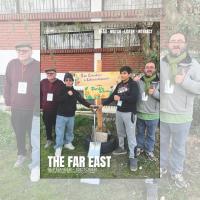
When I look back over the past sixty years, or seventy, considering the years in seminaries, I feel deep gratitude. First, I am very conscious of how God, through Jesus, who called me to be a Columban missionary, has constantly protected me during all those years. Above all, my father died of cancer a few days before I was three, leaving my mother with three preschool children. It was obviously a deep sadness, for we were too young to appreciate it, and we only saw our mother as someone who just took it for granted that her job was to bring us up with no fuss or self-pity. I now have inherited that positive attitude to face any difficulties head-on. I also owe a lot to the Sisters of Our Lady of the Missions at St Joseph's Convent School in Morrinsville whose faith was in all they did.
In 1953, almost by accident, I went to Holy Name Seminary in Christchurch. What happened was that the parish priest, Fr O'Connor, told me that Bishop Liston was coming down from Auckland to talk to my classmate, Mervyn Farrell, about going to Holy Name. He invited me to come to the meeting. I was surprised, but agreed, and next thing Merv and I were heading to Christchurch.
One day, two Columbans working in Japan, Kevin Lynch and Jim Norris, came to give us a talk and I realized that Kiwis could be overseas missionaries, so in 1960, I went to the Columban Seminary in Australia. I was ordained in Auckland on 4 July, 1964, and celebrated my First Mass in Morrinsville the following day.
Then it was back to the Seminary in Turramurra, Sydney, to receive our long-awaited mission assignments. While my classmates were assigned to South America and the Philippines, I was to do further studies in Rome. It was a valuable and enjoyable cross-cultural experience and after that I was appointed as a member of the seminary staff in Turramurra. During that time, I became an active member of the Catholic Bushwalking Club and spent happy times tramping in the Blue Mountains with good friends from the Club.
Seven years later, in 1974, I was assigned to Chile, where I arrived after language study for 4 months in Cochabamba, Bolivia. The next ten years in Chile were overshadowed by the military dictatorship which brought fear, oppression, torture and death to a people already made poor. A million fled the country and we began to take part in protest movements against the dictatorship. The Church was to the forefront in defending the people.
After three years in El Olivo in the North of Santiago, I was privileged to be asked to form the first Columban mission outside of the Archdiocese of Santiago. The diocese chosen was Arica, 2000 kilometres north of Santiago near the border with Peru. With Jim Sharp, a Scottish volunteer priest working with the Columbans, we went house hunting and were delighted when we discovered Cerro la Cruz, a very poor area on the edge of the desert. We were able to live close to the people and worked to form communities as well as family and youth groups.


Again, the effects of the dictatorship were felt, and the first protest that took place in Arica was to help in Cerro la Cruz where we sat blocking the road up the Morro, the summit where the Chilean army had defeated the Peruvians and annexed the city. Soon a contingent of soldiers arrived and faced us with drawn rifles. We sat them out until they finally left. The city president said that he would have no mercy with the communist priest in Cerro la Cruz but his daughter was a devout Mass goer and she interceded for me.
After seven happy years in the city of the Eternal Spring, I was surprised to find that I was included in the first Columban group to begin the new mission in Brazil. There were eleven of us assigned to the state of Bahia. Six went to the historical state capital, Salvador and five of us to the new Diocese of Barreiras, 1000 kilometres inland from Salvador. I spent the next nine years in the rural town of Baianopolis, visiting communities travelling up to 50 kilometres by bicycle on the sandy roads and staying overnight with families.
Then Dom Ricardo, the much-loved Austrian Benedictine Bishop, with whom we worked, asked me to come into the main centre for the diocese that later became a thriving town that sprung up over many years. While there I also spent much time visiting the prisons. Once the mother of a prisoner asked a Brazilian priest friend of mine for money to get a lawyer to work for the release of her son. My friend was unable to help, so she decided to take revenge on me. I was asked to take in a parcel for her son on my next visit. She advised the man in charge of the prison to open the parcel which was found to contain cognac and marijuana. As a result, I was locked up with the prisoners, which I didn't mind, as we were all good friends after so many visits. However, the news got out and lawyers from the diocese soon obtained my release.
After 14 years in Brazil, the Columban administration took the controversial decision to close our mission in Brazil. Four of us decided to join the diocese but eventually we were allowed to stay on as Columbans. During that time, Kiwi Columban Paul Prendergast asked me to join him in the Andes of Peru where he had been working alone for a number of years. By now, a number of young priests had been ordained for the Barreiras diocese and I felt that the time was right to go to Peru, where I stayed for the next 12 years.
I loved my life and work in the Andes, living at 3,400 metres in a totally rural situation where the Quechua speaking farmers worked hard to survive on the potatoes, maize, and beans they produced on their few hectares of land. I was helped by devoted catechists and missionaries who led the communities formed in the outlying villages. With the help of friends from Australia and Aotearoa New Zealand I was able to build a formation centre where we were able to run five-day courses for the Quechua speaking community leaders. In 2014 I was back in Aotearoa to celebrate 50 years of priesthood. I was asked to stay in the Wellington diocese to accompany refugees arriving from Colombia. I continue to do that and now our weekly Spanish mass is also attended by people from other South American countries. It is a blessing to be in Aotearoa and still be in contact with people from Spanish speaking countries.
Columban Fr Don Hornsey lives and works in New Zealand
Listen to "Celebrating 60 Years of faithful service - Fr Don Hornsey"
Related links
- Read more from The Far East - July 2024